 06:08
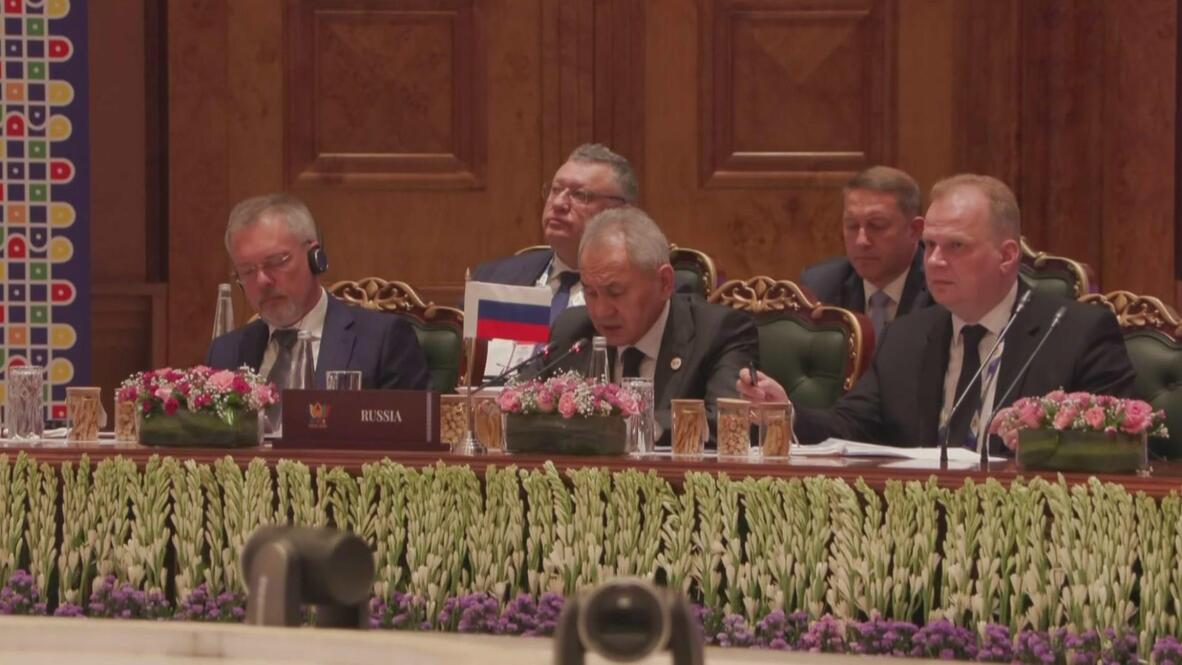
06:08Russian Security Council Secretary Sergei Shoigu said Western nations were the main cause of 'unprecedented instability in the world' speaking at a meeting of senior representatives of the BRICS countries in New Delhi on Tuesday.
"The main cause behind the unprecedented instability in the world is clearly the desire of the elites of the Сollective West to maintain their dominance, whilst ignoring the fact that a multipolar world order is taking shape," he noted.
He added that the long-running crisis around the Strait of Hormuz, after the Iran war, had threatened global energy and food security, said it was further complicated by Western attempts to damage Russian port and production infrastructure - and attacked the West's so-called 'rules based order', or the 'law of the strongest'.
"In the current climate, it is more important than ever to review international institutions. It is crucial to preserve the coordinating role of the international law system, which some are attempting to replace with a new law of the strongest - a so-called rules-based order. It is BRICS that must take the lead in managing the situation in order to establish a just architecture for international relations," he added.
Shoigu also called for the creation of an independent communications infrastructure for the BRICS countries, suggesting Russian low-orbit satellites as an alternative to the foreign Starlink and OneWeb systems.
India hosts the BRICS National Security Advisers Meeting on June 22-23. The event is expected to focus on strengthening co-ordination among BRICS countries, as well as international and regional security issues.
Western elites cause 'unprecedented instability in the world' - Russia’s Shoigu at BRICS security meeting
Russian Security Council Secretary Sergei Shoigu said Western nations were the main cause of 'unprecedented instability in the world' speaking at a meeting of senior representatives of the BRICS countries in New Delhi on Tuesday.
"The main cause behind the unprecedented instability in the world is clearly the desire of the elites of the Сollective West to maintain their dominance, whilst ignoring the fact that a multipolar world order is taking shape," he noted.
He added that the long-running crisis around the Strait of Hormuz, after the Iran war, had threatened global energy and food security, said it was further complicated by Western attempts to damage Russian port and production infrastructure - and attacked the West's so-called 'rules based order', or the 'law of the strongest'.
"In the current climate, it is more important than ever to review international institutions. It is crucial to preserve the coordinating role of the international law system, which some are attempting to replace with a new law of the strongest - a so-called rules-based order. It is BRICS that must take the lead in managing the situation in order to establish a just architecture for international relations," he added.
Shoigu also called for the creation of an independent communications infrastructure for the BRICS countries, suggesting Russian low-orbit satellites as an alternative to the foreign Starlink and OneWeb systems.
India hosts the BRICS National Security Advisers Meeting on June 22-23. The event is expected to focus on strengthening co-ordination among BRICS countries, as well as international and regional security issues.
Russian Security Council Secretary Sergei Shoigu said Western nations were the main cause of 'unprecedented instability in the world' speaking at a meeting of senior representatives of the BRICS countries in New Delhi on Tuesday.
"The main cause behind the unprecedented instability in the world is clearly the desire of the elites of the Сollective West to maintain their dominance, whilst ignoring the fact that a multipolar world order is taking shape," he noted.
He added that the long-running crisis around the Strait of Hormuz, after the Iran war, had threatened global energy and food security, said it was further complicated by Western attempts to damage Russian port and production infrastructure - and attacked the West's so-called 'rules based order', or the 'law of the strongest'.
"In the current climate, it is more important than ever to review international institutions. It is crucial to preserve the coordinating role of the international law system, which some are attempting to replace with a new law of the strongest - a so-called rules-based order. It is BRICS that must take the lead in managing the situation in order to establish a just architecture for international relations," he added.
Shoigu also called for the creation of an independent communications infrastructure for the BRICS countries, suggesting Russian low-orbit satellites as an alternative to the foreign Starlink and OneWeb systems.
India hosts the BRICS National Security Advisers Meeting on June 22-23. The event is expected to focus on strengthening co-ordination among BRICS countries, as well as international and regional security issues.