 04:16
04:16Mandatory credit: SABC. News use only
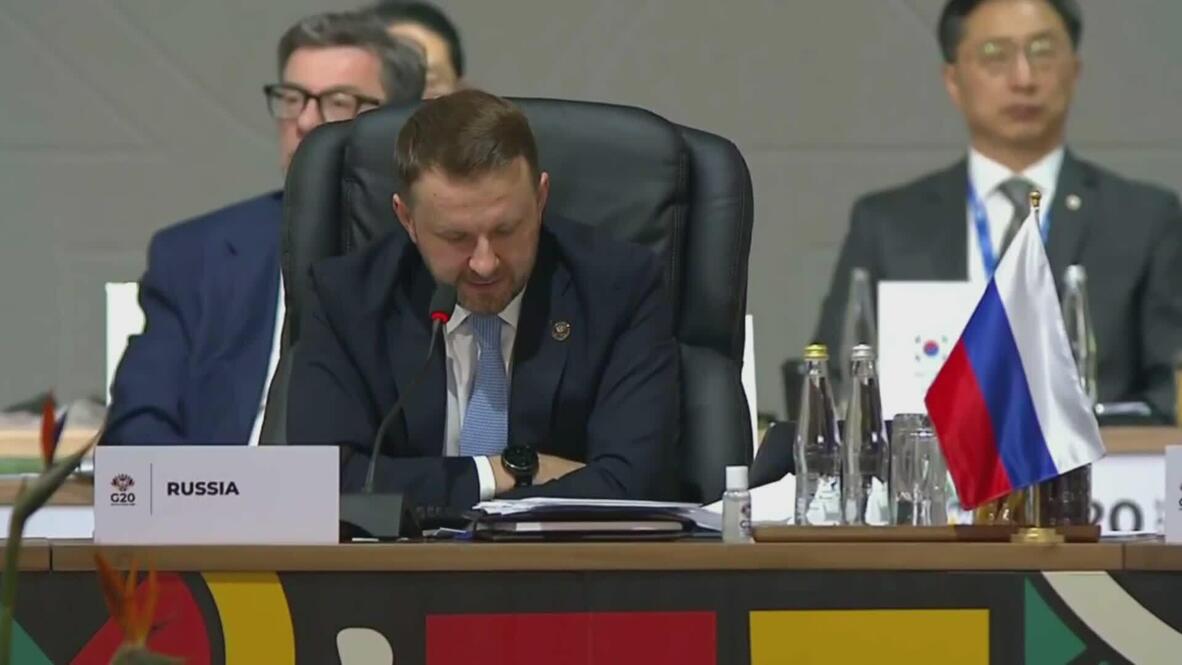
Russian Deputy Chief of Staff of the Presidential Executive Office, Maxim Oreshkin, said BRICS and Global South nations have become the 'dominant driver' of global economic growth, speaking at the G20 Summit in Johannesburg on Saturday.
“BRICS and countries of the Global South now form the dominant driver of global growth. We have the talent, the resources, the technology and the capacity to drive growth and improve the lives of our people,” he said. “Unlike in previous decades, the Global South's economies are ready this time to move forward with their own platform for economic growth, based on their own solutions.”
Oreshkin warned that the international economic system was 'facing a severe fragmentation', accusing advanced economies of resorting to “illegitimate unilateral actions, including sanctions, trade barriers, technological and educational restrictions, as well as seizure of sovereign assets”.
“These methods of unfair competition destabilise the global economic architecture, disrupt supply chains, discourage long-term investments, hold back global growth and undermine progress in achieving the sustainable development goals,” he added.
Oreshkin also claimed that the international financial institutions are "deviating from development finance to military expenditures", adding that money went "back to the Western economies and in many cases through the corruption schemes in Ukraine".
"The World Bank, for example, has provided Ukraine with more aid in three years than to all African countries combined. Moreover, African economists face biased rejections and complicated procedures of funding from the World Bank and the IMF. Definitely all these institutions should be reformed to benefit the Global South," he continued.
The two-day G20 Summit, the first hosted on African soil, brings together 42 countries and international organisations. This year’s gathering, concluding on Sunday, is focused on strengthening inclusive global growth, supporting a just energy transition and accelerating progress toward UN Sustainable Development Goals.
BRICS, Global South now 'dominant driver' of world's economic growth - Russia's Oreshkin at G20
Russian Deputy Chief of Staff of the Presidential Executive Office, Maxim Oreshkin, said BRICS and Global South nations have become the 'dominant driver' of global economic growth, speaking at the G20 Summit in Johannesburg on Saturday.
“BRICS and countries of the Global South now form the dominant driver of global growth. We have the talent, the resources, the technology and the capacity to drive growth and improve the lives of our people,” he said. “Unlike in previous decades, the Global South's economies are ready this time to move forward with their own platform for economic growth, based on their own solutions.”
Oreshkin warned that the international economic system was 'facing a severe fragmentation', accusing advanced economies of resorting to “illegitimate unilateral actions, including sanctions, trade barriers, technological and educational restrictions, as well as seizure of sovereign assets”.
“These methods of unfair competition destabilise the global economic architecture, disrupt supply chains, discourage long-term investments, hold back global growth and undermine progress in achieving the sustainable development goals,” he added.
Oreshkin also claimed that the international financial institutions are "deviating from development finance to military expenditures", adding that money went "back to the Western economies and in many cases through the corruption schemes in Ukraine".
"The World Bank, for example, has provided Ukraine with more aid in three years than to all African countries combined. Moreover, African economists face biased rejections and complicated procedures of funding from the World Bank and the IMF. Definitely all these institutions should be reformed to benefit the Global South," he continued.
The two-day G20 Summit, the first hosted on African soil, brings together 42 countries and international organisations. This year’s gathering, concluding on Sunday, is focused on strengthening inclusive global growth, supporting a just energy transition and accelerating progress toward UN Sustainable Development Goals.
Russian Deputy Chief of Staff of the Presidential Executive Office, Maxim Oreshkin, said BRICS and Global South nations have become the 'dominant driver' of global economic growth, speaking at the G20 Summit in Johannesburg on Saturday.
“BRICS and countries of the Global South now form the dominant driver of global growth. We have the talent, the resources, the technology and the capacity to drive growth and improve the lives of our people,” he said. “Unlike in previous decades, the Global South's economies are ready this time to move forward with their own platform for economic growth, based on their own solutions.”
Oreshkin warned that the international economic system was 'facing a severe fragmentation', accusing advanced economies of resorting to “illegitimate unilateral actions, including sanctions, trade barriers, technological and educational restrictions, as well as seizure of sovereign assets”.
“These methods of unfair competition destabilise the global economic architecture, disrupt supply chains, discourage long-term investments, hold back global growth and undermine progress in achieving the sustainable development goals,” he added.
Oreshkin also claimed that the international financial institutions are "deviating from development finance to military expenditures", adding that money went "back to the Western economies and in many cases through the corruption schemes in Ukraine".
"The World Bank, for example, has provided Ukraine with more aid in three years than to all African countries combined. Moreover, African economists face biased rejections and complicated procedures of funding from the World Bank and the IMF. Definitely all these institutions should be reformed to benefit the Global South," he continued.
The two-day G20 Summit, the first hosted on African soil, brings together 42 countries and international organisations. This year’s gathering, concluding on Sunday, is focused on strengthening inclusive global growth, supporting a just energy transition and accelerating progress toward UN Sustainable Development Goals.